
You have a business idea that sounds great. But before you spend months building a product or thousands of dollars on marketing, you need to answer one critical question: will anyone actually pay for it?
Key Idea
Don’t validate a business idea with optimism. Validate it with evidence.
As an entrepreneur, you must think like an engineer: treat your idea as a hypothesis, build a test, measure the results, and analyze the financial reality. In this guide, we will walk through a structured, analytical approach to validating your business idea using both customer feedback and basic financial feasibility.
The Validation Framework: From Idea to Evidence
Validation is the process of gathering evidence that your business concept is both desired by the market and financially viable. You move from “I think people want this” to “I have proof people will pay for this.”
Here is the structured path your idea must survive:
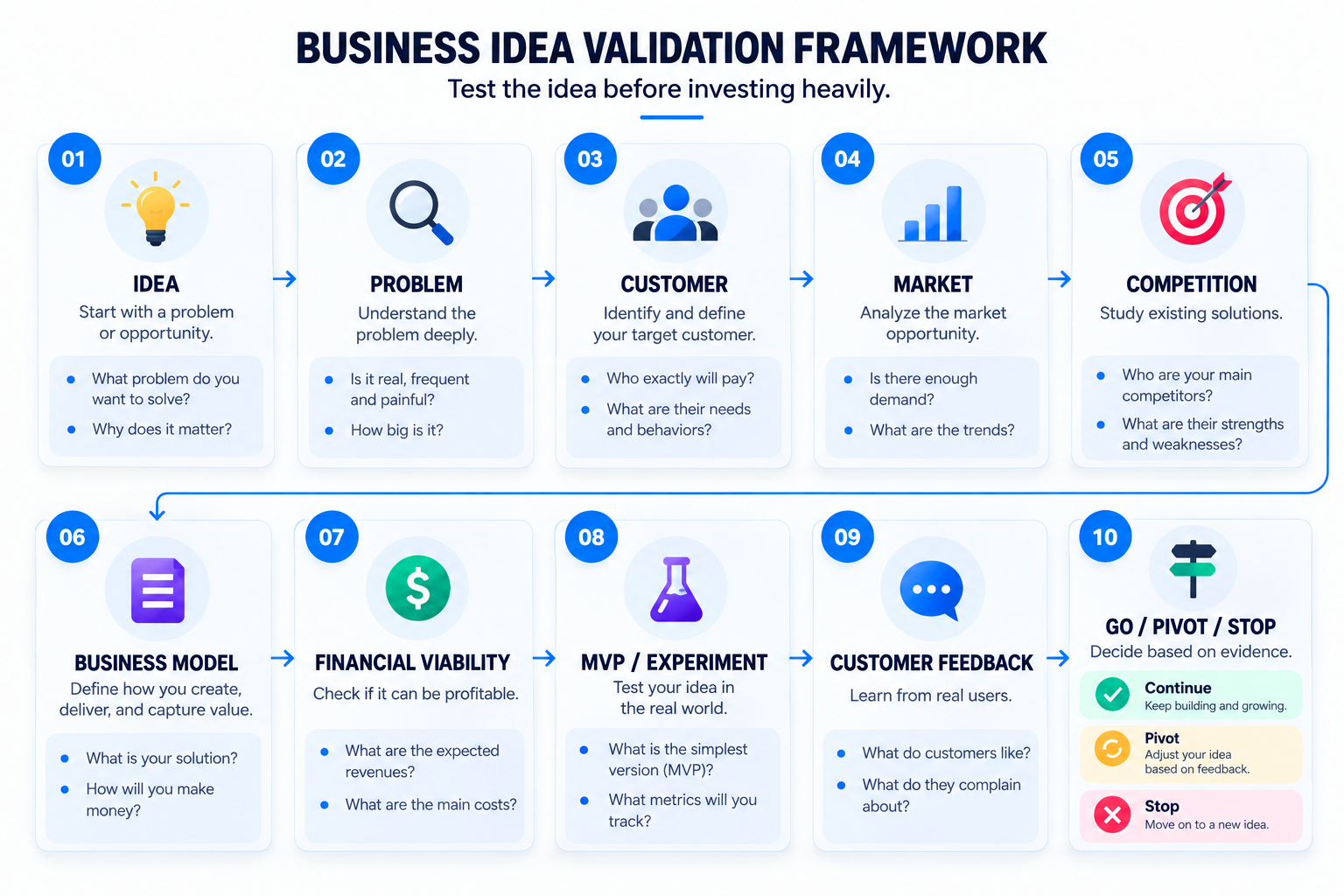
To make this concrete, we will use one running example throughout this guide: A student who wants to start a healthy meal-preparation service for university students.
1. Defining the Core Variables (The Qualitative Test)
Before running experiments, you need to define your assumptions using established business tools. You do not need a 50-page document; you just need clarity.
Essential Business Tools for Early Validation
These frameworks help you answer specific questions without getting lost in theory:
- Business Model Canvas / Lean Canvas: A 1-page visual map of your entire business strategy. Question: How does the whole system work together?
- Customer Persona: A detailed profile of your ideal buyer. Question: Who exactly is experiencing this problem?
- Value Proposition Canvas: Maps customer pains and gains to your product’s specific features. Question: Does our solution actually relieve their specific headache?
- Competitor Analysis Matrix: A structured table comparing existing alternatives. Question: How do customers solve this today, and where are the gaps?
- SWOT Analysis: Strengths, Weaknesses, Opportunities, Threats. Question: What are our internal advantages and external risks?
- MVP (Minimum Viable Product): The simplest possible version of your product that allows you to start learning from real customers. Question: Will people actually pull out their credit card for this?
The Student Meal-Prep Example: The Canvas
Instead of writing a massive business plan, our entrepreneur maps out the core assumptions on a lightweight Business Model Canvas:
| Component | Assumption for the Meal-Prep Service |
|---|---|
| Problem | Students eat expensive, unhealthy fast food because they lack time to cook. |
| Customer | 2nd & 3rd-year university students with part-time jobs. |
| Solution | Weekly delivery of 5 pre-cooked, healthy, microwaveable meals. |
| Competitors | Campus cafeterias, UberEats, grocery store frozen meals. |
| Revenue Model | Subscription model: 45/week per student. |
| Costs | Ingredients, packaging, delivery gas, kitchen rental time. |
2. Market and Competitor Analysis
Competition proves that a market exists. If our student finds out that other meal services exist, that is validation, not a reason to quit. You just need to understand where you fit in.
Competitor Comparison Matrix
Use a simple table to find your competitive advantage:
| Competitor | Price per Meal | Health Quality | Convenience | Weakness |
|---|---|---|---|---|
| Campus Cafeteria | 12 - 15 | Moderate | High (on campus) | Overpriced, repetitive menus. |
| UberEats (Fast Food) | 15 - 20 | Low | High (delivered) | Too expensive for daily use, unhealthy. |
| Our Meal-Prep Idea | 9.00 | High | High (delivered) | Requires planning ahead (subscription). |
Conclusion: The meal-prep service wins on price and health, but loses on instant gratification. This tells the student exactly how to market the product.
3. Financial Viability (The Quantitative Test)
A business that solves a problem but loses money on every transaction is just a fast-track to bankruptcy. Before launching, you must understand the difference between early-stage operational metrics and long-term project feasibility.
Early-Stage Validation Metrics (What to track right now)
When launching your MVP, these are the unit economics that matter:
- Gross Margin / Gross Profit: Revenue minus the direct cost of making the product. (If a meal costs 4 in ingredients and sells for 9, the gross profit is 5).
- Break-even Point: How many units must you sell to cover your fixed costs?
- Customer Acquisition Cost (CAC): How much you spend on marketing to get one paying customer.
- Customer Lifetime Value (LTV): How much profit a customer brings before they cancel.
- ROI (Return on Investment): For an early stage, this is a basic measure of the profit generated from the money you invested in your marketing or initial setup.
Investment / Project Feasibility (For later stages)
If you eventually seek investors or bank loans to build a massive commercial kitchen, you will need advanced financial indicators. You do not need to calculate these for a tiny MVP, but you should understand the concepts:
- VAN / NPV (Net Present Value): Does the project create total value after considering the time value of money and your initial investment?
- TRI / IRR (Internal Rate of Return): What approximate percentage return rate does this investment generate over its lifespan?
- IP (Profitability Index): How much value is generated relative to the capital invested?
- Payback Period: How many months or years will it take to recover the initial investment?
Financial Validation Mini-Table (Meal-Prep Example)
Let’s look at the early-stage math for the meal-prep MVP (note: these are illustrative amounts, not universal prices):
| Metric | Target / Assumption | Calculation | Result |
|---|---|---|---|
| Price per week (5 meals) | 45.00 | Revenue | 45.00 |
| Cost of Goods (Food + Box) | 20.00 | Direct Costs | 20.00 |
| Gross Profit per customer | 25.00 | 45 - 20 | 25.00 Gross Profit/Week |
| Fixed Costs (Kitchen Rent) | 100.00 / week | Overhead | 100.00 |
| Break-even Point | 4 Customers | 100 / 25 | Need 4 active subs |
Conclusion: The financial model is viable. At 4 weekly subscribers, the student breaks even (operating profit = 0). With 5 subscribers, the student generates their first positive operating profit, assuming the simplified model remains unchanged.
4. The MVP and Customer Feedback
Now that the logic and math make sense, we must test it in the real world. A Minimum Viable Product (MVP) is an experiment designed to measure actual customer behavior.
Stop Asking for Compliments. Ask for Commitment.
Do not ask people, “Would you use this?” People will say yes just to be polite. Instead, ask for a commitment: an email address, a deposit, or a pre-order.
For the meal-prep service, the MVP is not renting a commercial kitchen and building an app.
The Meal-Prep MVP
The student creates a simple WhatsApp group or a one-page website, posts the menu for next week, and messages 30 classmates: “I am cooking 5 healthy meals for next week. It costs 45. I only have capacity for 5 people. Send a deposit to secure your spot.”
Collecting and Analyzing Feedback
If nobody sends money, it is a strong signal that you need to reconsider the offer, the target customer, the price, the problem, your positioning, or trust. It does not automatically mean the entire business idea is worthless, but it means your current approach needs adjustment. The student must then interview those who declined:
- Was the price too high?
- Did they not like the menu?
- Did they not trust the student’s cooking?
5. The Lightweight Business Plan
Before investing significant money, an entrepreneur can formalize these learnings into a lightweight business plan. Keep it concise. This document is simply a set of assumptions that must be actively tested, not a guarantee of success.
Your lightweight plan should cover:
- Problem: The specific pain point.
- Target Customer: The exact demographic experiencing the problem.
- Solution: How your product relieves the pain.
- Market: The size and accessibility of your audience.
- Competitors: Existing alternatives.
- Business Model: How you deliver value and capture revenue.
- Marketing and Sales: Your strategy for acquiring customers (CAC).
- Operations: How you fulfill the product.
- Costs: Fixed and variable expenses.
- Revenue Assumptions: Pricing, volume, LTV.
- Risks: What could destroy this business.
- Financial Projections: Break-even and early cash flow.
The Final Decision: GO, PIVOT, or STOP
Validation reduces uncertainty. It does not guarantee success. After running your MVP, you must look at the data objectively and make a decision:
- GO: The evidence is strong enough to continue. (Example: 8 students tried to pre-order, the math works out, the margin is healthy).
- PIVOT: The evidence suggests the problem, customer, or offer needs adjustment. (Example: Students won’t pay 45 for 5 meals, but they will pay 25 for 3 lunches). Change one variable and test again.
- STOP: The evidence is too weak to justify continuing. (Example: No one paid, everyone said they prefer to cook their own food or eat at the cafeteria). Abandon the idea and save your money.
Your Validation Checklist
Before moving forward with any idea, ensure you can check these boxes:
- I have mapped my core assumptions on a Business Model Canvas.
- I have analyzed how competitors currently solve the problem.
- I have calculated my unit economics (Costs, Margin, Break-even point).
- I have designed a low-cost, low-effort MVP to test willingness to pay.
- I have asked for money or serious commitment, not just opinions.
- The data clearly points to GO, PIVOT, or STOP.
If your idea survives this process, you are no longer relying on optimism. You have a solid, evidence-based foundation to build upon. If you haven’t yet settled on an idea to put through this framework, revisit our guide on How to Find a Business Idea to uncover new opportunities.